Wash day on the Camino

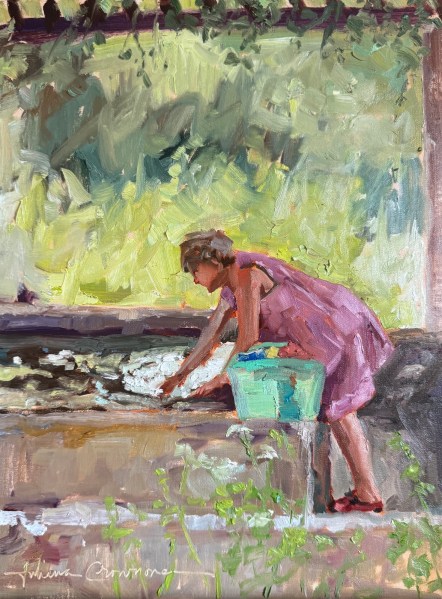
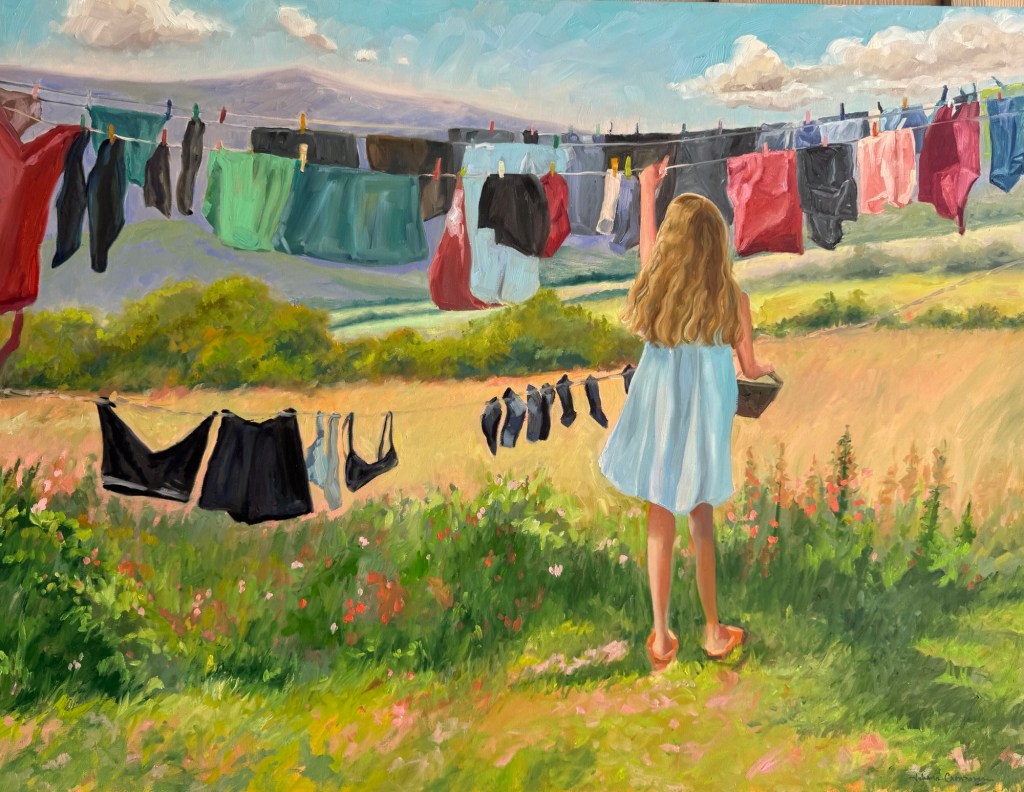
36”x48” oil on canvas

Wash Day

One afternoon, I stopped to watch two women doing laundry.

They were not pilgrims. They lived in the village and, like the women in the generations before them, they were washing clothes in an old communal stone basin. Water flowed steadily through the washhouse, as it had for centuries.

I wondered how many pilgrims had paused there before me—to fill a bottle, rinse a pair of socks, or simply watch ordinary life unfold.

The women worked easily together. One scrubbed while the other rinsed. They talked and laughed, their hands moving steadily through the water.

They made the work look almost light.

It struck me that they understood something we have nearly forgotten:

Work is easier when it is shared.

The Camino has a way of making this obvious.

You walk.

You sweat.

You wash your clothes.

The next day, you do it again.

There is no pretending that life is not made up of ordinary maintenance.

Every evening, clotheslines stretched between albergues and across courtyards, fluttering with shirts, socks, towels, and underwear from every corner of the world. Pilgrims gathered around sinks with bars of soap, exchanging stories as they scrubbed away another day’s dust.

Laundry was not separate from the pilgrimage.

It was part of it.

Watching the women at the stone basin reminded me of stories my grandmother told about Mondays at the laundromat.

Wash day was not simply about getting the clothes clean. Women from the neighborhood arrived with baskets of laundry, thermoses of coffee, sandwiches, and whatever dessert someone had baked that week. While the washing machines churned, they played cards and caught up on one another’s lives. Their children played nearby, weaving between baskets and folding tables.

The work created the gathering.

My own friends and I often did the opposite. We hurried through chores as efficiently as possible so we could take our children somewhere enjoyable: a park, a playground, somewhere that felt as though life were happening.

But those women let life happen where the work needed to be done.

Perhaps we have become so efficient that we have accidentally made ourselves lonely. Larger houses, better appliances, and private laundry rooms have made chores faster, but they have also made them solitary.

Convenience has given us speed.

It has stealthily taken away companionship.

One afternoon, my daughter stood beneath long clotheslines stretched across a hillside. Freshly washed clothes moved in the Spanish breeze while mountains rose in the distance.

She handed me clothespins as we hung our laundry together.

I remember thinking that this was a far more beautiful place to dry clothes than the inside of an electric dryer.

The Camino taught me that caring for ordinary things is not separate from a meaningful life.

It is the meaningful life.

Every day, our clothes become dirty.

Every day, we wash them.

Perhaps our souls are much the same.

They need regular tending—not because something has gone wrong, but because this is the rhythm of being human.

We walk dusty roads.

We gather around shared work.

We wash what has been soiled.

And each morning, we begin again—with clean clothes, lighter hearts, and gratitude for the hands working beside us.

ART SHOW!!! I’d love to invite you to the opening of When the Road Becomes Prayer: Paintings from the Camino de Santiago, an exhibition of paintings inspired by my family’s pilgrimage across Spain.

Please join me for the Opening & Artist Reception on Sunday, September 27 at 2:00 PM at the Justus Sundermann Gallery at St. Matthew’s Cathedral, 5100 Ross Avenue in Dallas. Admission is free, and covered parking is available.

I would be so happy to see you there. Come walk a little of the Camino with me.

A Pilgrim’s Pause

12” · 12” Oil, cold wax, and collage

A Pilgrim’s Pause

The Camino took us through the middle of life.

Through tiny villages and busy cities, past open windows, cafés, shopkeepers, children playing, laundry hanging, and neighbors talking in the street.

We were walking through Spain at the speed of humans—slowly enough to notice.

This painting holds one of those ordinary moments: a pilgrim pausing on a street while life continues around her.

Nothing extraordinary happened.

And perhaps that is why I wanted to paint it.

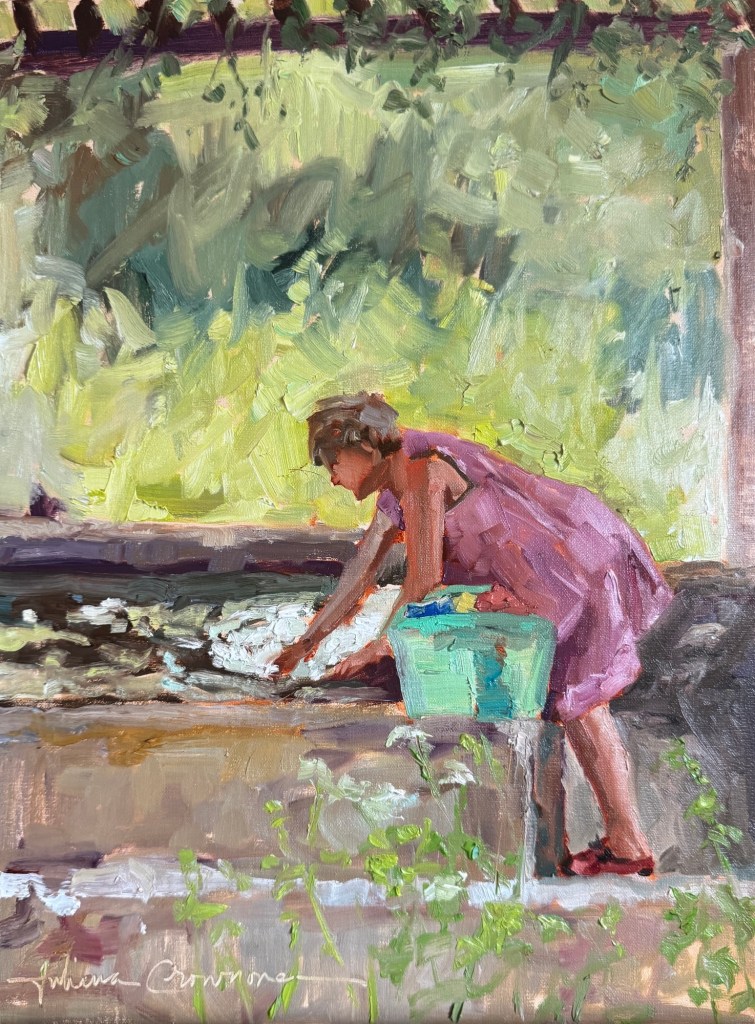
“The Washerwoman”

16”x12” oil on linen

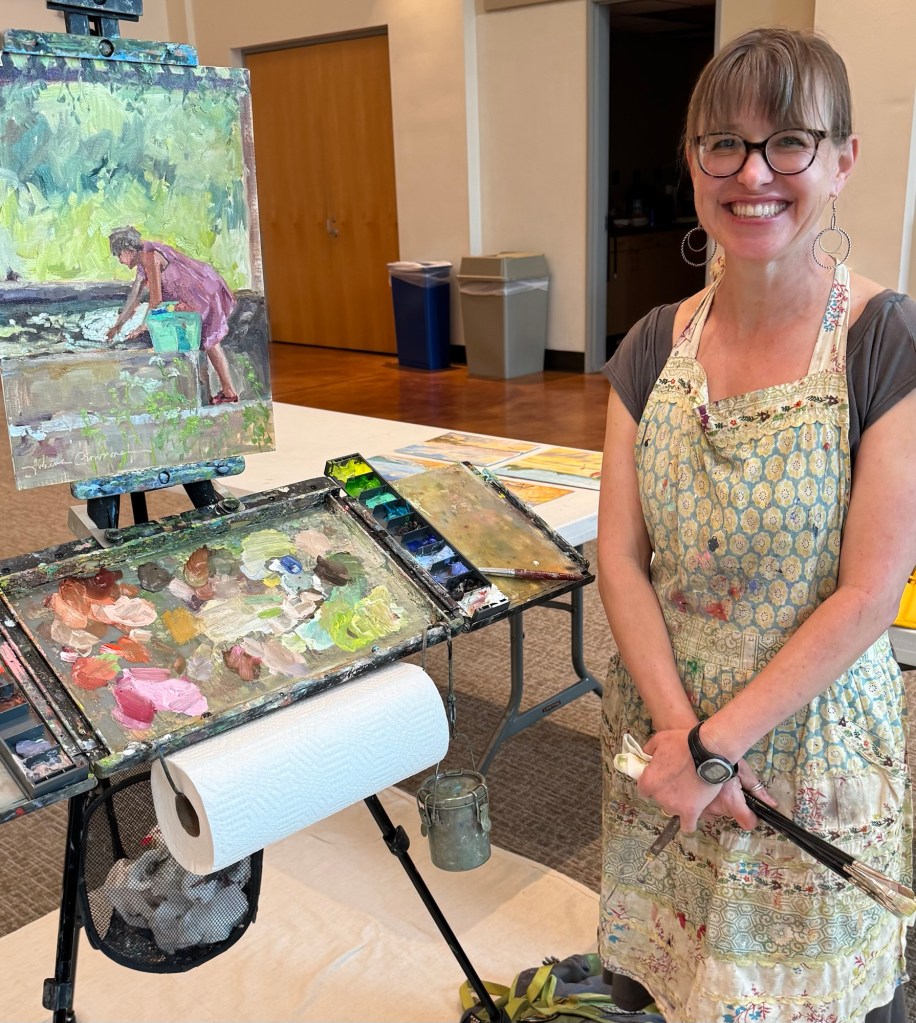
I painted a demo today for ACA (Associated Creative Artists) in Dallas today. What a delightful group! This painting is of a woman who was washing clothes in Melide, Spain. She was on the Camino, but she wasn’t a pilgrim. She was just using this beautiful stone laundry plaza. I wanted to capture the light, and the way common everyday tasks connect us.

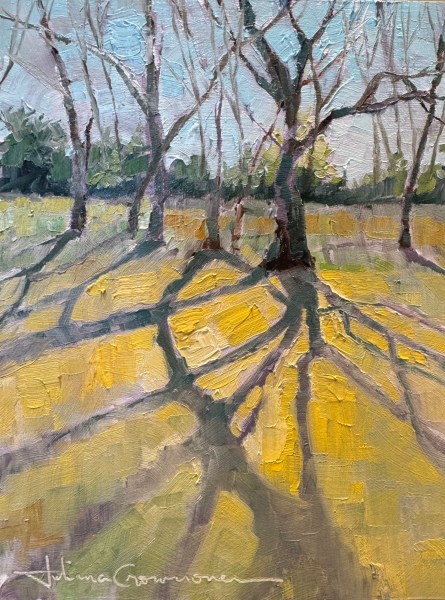
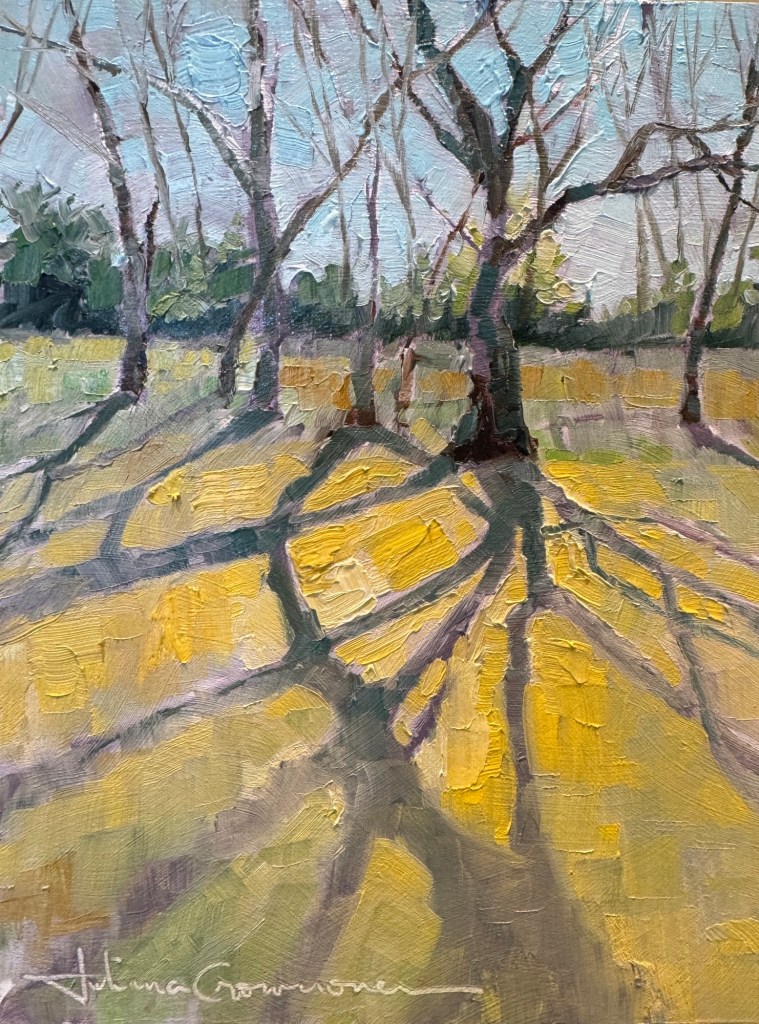
The Bones of Living

8”x6” oil on cradled panel

This is a little demo I did for a one day workshop I taught today in Sunnyvale, TX. We talked about composition, abstracting nature, and what a tonal underpainting can do to add atmosphere to a painting.

This painting explores the threshold between decay and renewal. At first glance the trees seem lifeless, stripped down to what remains after growth has passed. Yet the light seeps through and around these forms like breath in a body. Transforming what could feel desolate into something hopeful, reminding us that even in bareness there is vitality. The trees are not dead; they are enduring. Their exposed structure becomes a testament to resilience—the underlying framework that allows life to return.

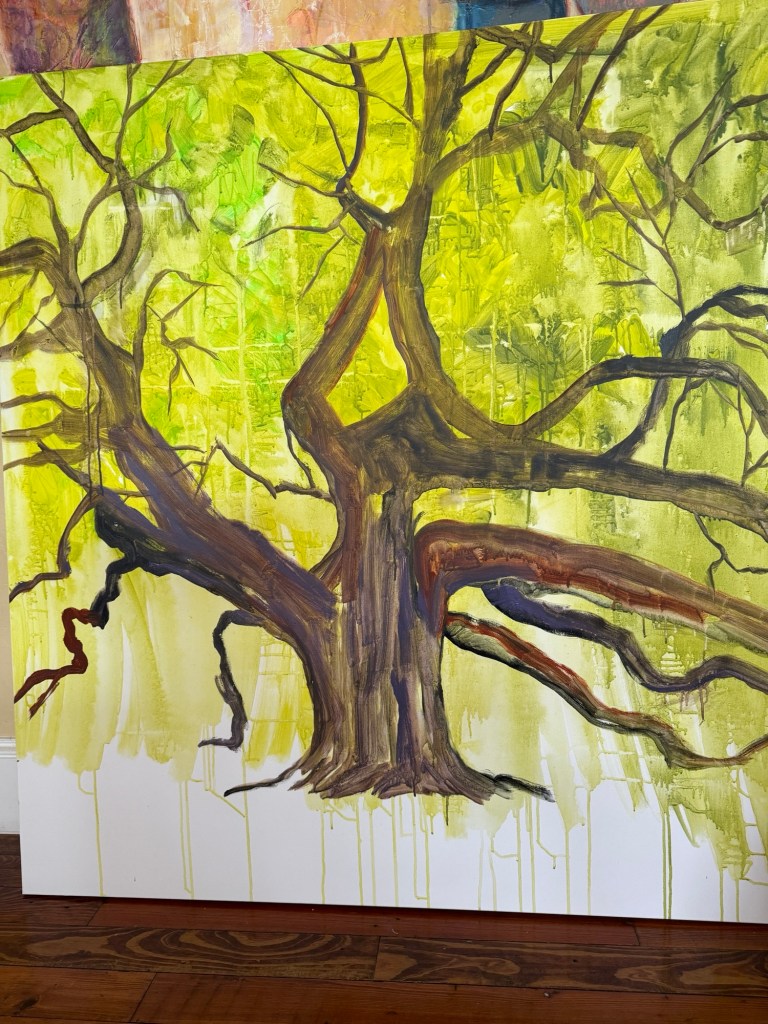
Family Tree: Deep Roots Wide Branches

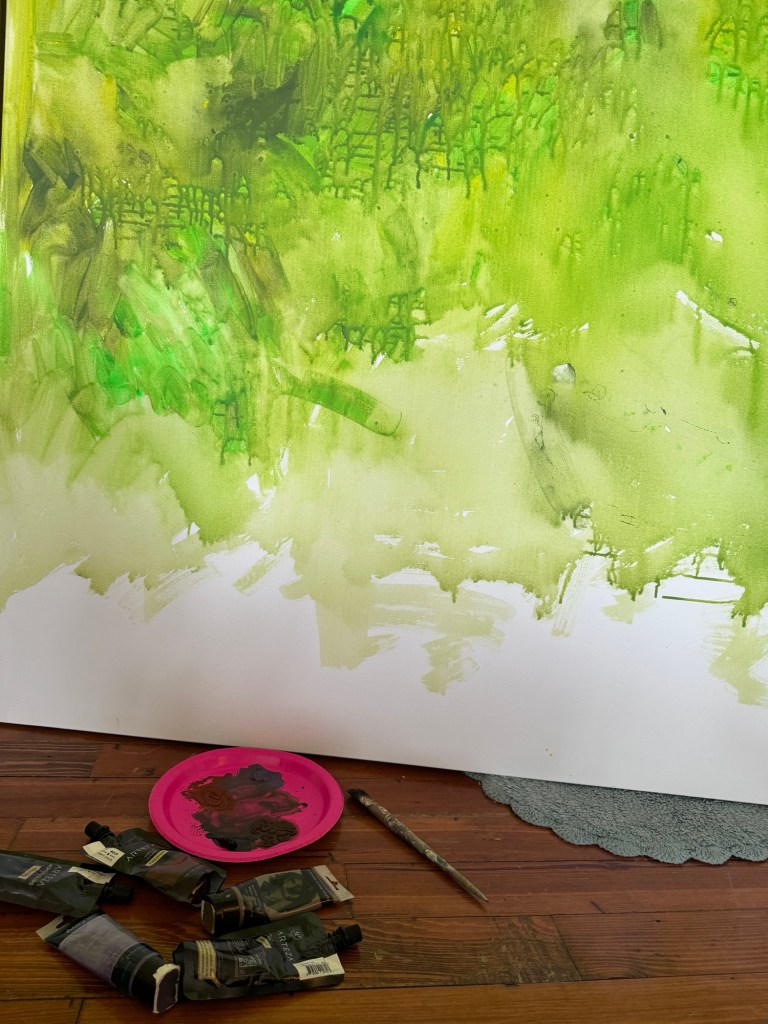
I’m so excited today I am prepping materials for family day at the DMA. I am the feature community artist and my project is: “Deep Roots and Wide Branches”

Come co-create a collaborative piece of art with me at the Dallas Museum of Art tomorrow!! Come write your family story into our collaborative art project. What makes your family special? Is it your deep roots or your wide stretching branches?

“my great granny made me feel like I was the only person on earth and that we had all the time in the world.”

“We all sit down every night for dinner at 6, and everyone can always bring a friend, it can be pretty crazy, but our dinner table is how I think of my home and family.”

Come paint, come play, and come write your story into our family tree. You will have the chance to try out a variety of mixed media tools and techniques, Our collaboration will be structured with enough direction to ensure success and enough freedom to allow for creative expression. DMA Saturday Nov. 2nd 11am-4pm

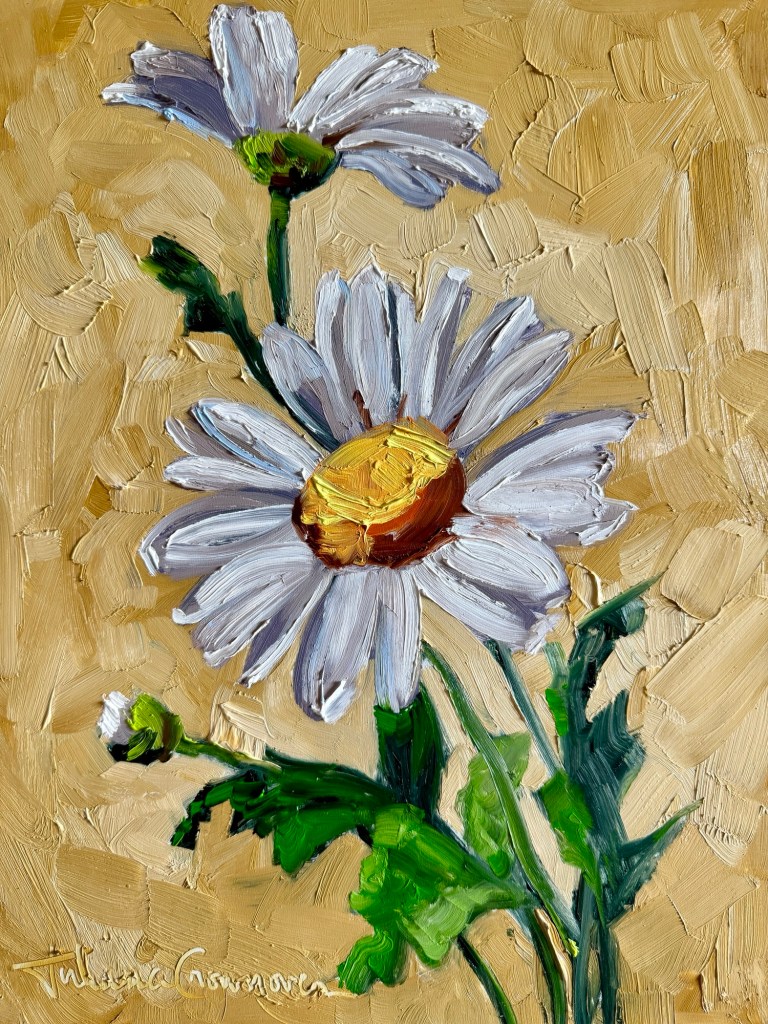
Rooted Friendship

14”x11” oil on panel

“Friendship plants itself as a small unobtrusive seed; over time, it grows thick roots that wrap around your heart”. -Anna Lyndsey

My mom asked if I would paint a daisy image for the cover of a yearbook she was compiling. The yearbook was for PEO, a women’s group she has been part of for over 40 years. I have so much respect for the work and relationships she and her friends have nurtured through that organization. Like the seeds of a daisy, those friendships have grown thick roots around not only their hearts, but mine as well. (You know it is a deep friendship, when love extends to an adult daughter.)

So, here is the daisy, which I was delighted and honored to paint, and may their friendships continue to bloom for many years to come.

Journey to the Cross

“Blessed are you pilgrim, if your backpack empties of things and your heart doesn’t know how to hold so many emotions.”

The Cruz de Ferro (Iron Cross) is located on the Camino de Santiago. Specifically, it is located on the highest point of the French way between the towns of Manjarín and Foncebadón.

Pilgrims traditionally leave a stone at the Cruz de Ferro. Most people bring a stone from their home. The stone represents a burden: physical, and symbolic.

The cross is 550km (340 miles) from where we started in St. Jean Pied de Port, France.

The day we arrived in France, we got off the train and met a pilgrim I would end up walking many days with. She was 20 years older than me, and 20 times fitter than I was. We were, however, the same height, which it turns out is a key in determining stride. We made good walking partners. We shared stories as we walked. Like many pilgrims, our packs were too heavy at the beginning. The subject of the rocks came up a lot. She was carrying not only her rock, but rocks for friends who couldn’t walk the miles themselves to the Iron Cross. As our friendship increased, she shared that she was carrying a letter of forgiveness for a hurt that she had been holding into for more than 50 years, she planned to lay it at the iron cross.

Sometime before we reached the Cruz de Ferro, our rest days didn’t line up and me and my walking buddy were separated. The day we climbed to the cross, I walked in the pouring rain with my daughters. It was somber as we climbed the hill. The Cruz de Ferro wasn’t just a giant pile of rocks, there were letters, photos, baby shoes and all kinds of mementos. You could feel the emotions from the centuries piled up. I imagined the burdens and prayers floating to heaven in the stormy clouds. After days of separation, my friend and I met again at the exact moment we reached the cross. With a tear stained face, and a smile that stretched from ear to ear she told me “I left it at the foot of the cross and I feel lighter.”

Today is Good Friday. As I journey to the cross today, my journey will be the same symbolic one Christians have journeyed for centuries. My pilgrimage will be the stations of the cross. Since the Middle Ages, people unable to walk a religious pilgrimage, would walk the stations.

The cross will be waiting for us.

48”x24” mixed media. “Journey to the Cross”

Detail