The Weight We Choose

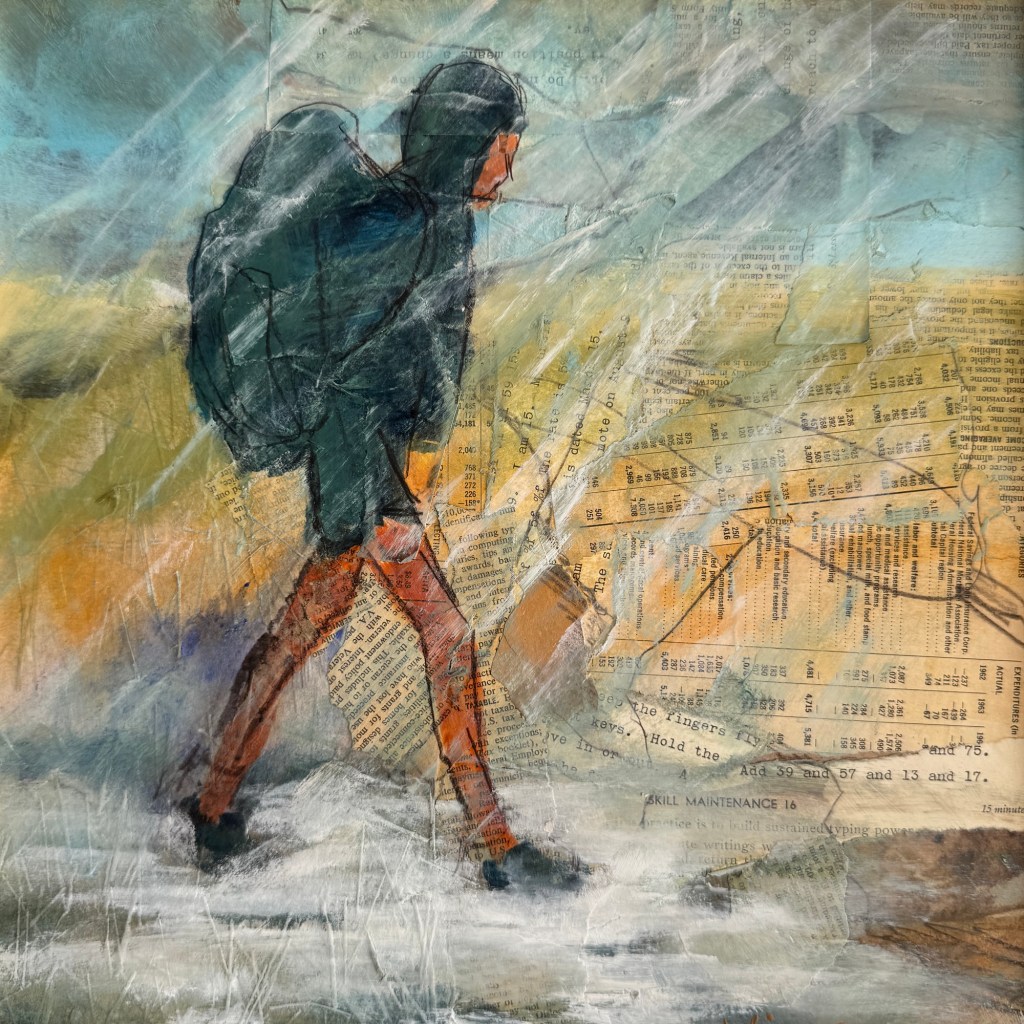
12” · 12” oil, cold wax, and collage

The Pack of Fear

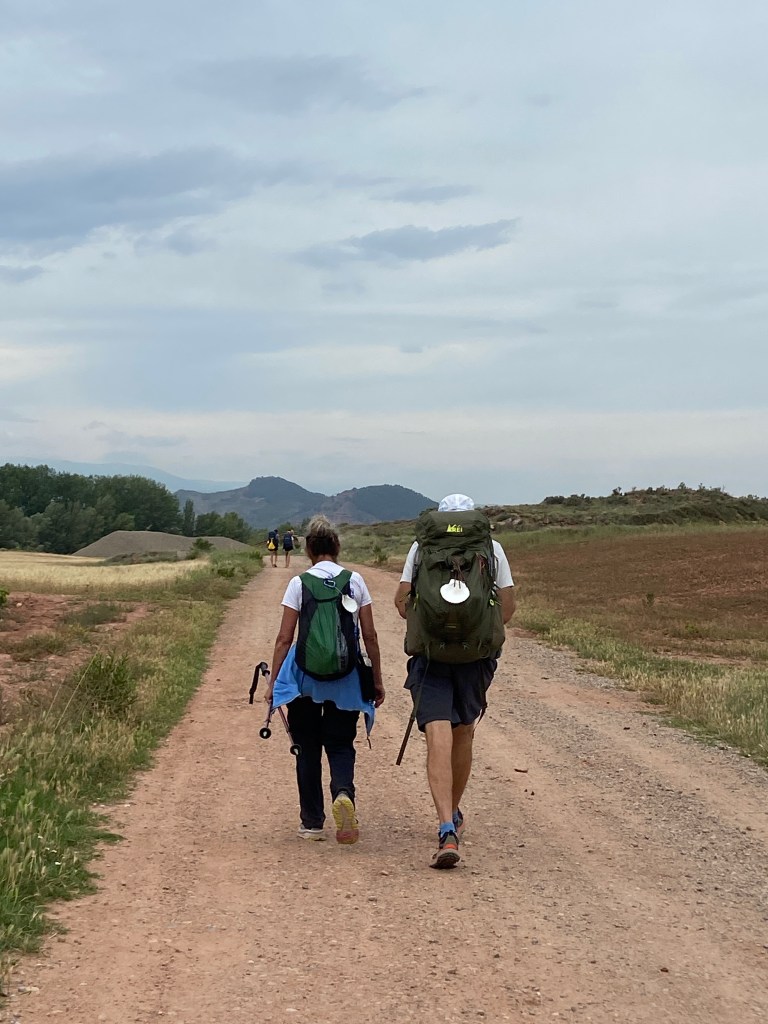
At the beginning of the Camino, I hated my pack.

It clung to me—a stubborn weight, always present, always asking something of my body. I thought it was heavy because I was not strong enough.

But it was heavy because it was full of fear.

I had packed for every what if, every just in case, every quiet doubt that whispered I would not be enough unless I carried more.

I am a mother. I am the one who anticipates, prepares, and provides. I carry the extra snacks, the medicine, the rain gear, and the things no one thinks they will need until suddenly, they do.

I am the just in case.

Also, I come from abundance, from a life in which there is usually more than enough. More food than we eat. More clothing than we wear. More belongings than we use.

Still, we gather more.

Excess has a cost.

What we carry, we must tend.

What we own, we must store, protect, and keep.

Too often, what we keep is never used at all.

Day after day, as we walked from village to village, I began to notice small cloth bags hanging beside doors and mailboxes.

At first, I did not understand what they were.

Then I smelled the bread truck before I saw it—warm, yeasty, alive.

The truck passed through villages without bakeries, leaving bread in the waiting bags. Each household received only what it needed for that day.

Give us this day our daily bread.

In the desert, the Hebrews learned that tomorrow’s provision could not be gathered in advance. Manna would not keep. It could not be stored or controlled, only received and used.

I had spent much of my life trying to gather tomorrow’s bread today.

I carried extra food because someone might get hungry. I carried things my children could carry for themselves. I carried the fear that if I did not anticipate every need, someone would go without—and it would be my fault.

Slowly, the Camino began to loosen my grip.

I did not need to carry food for everyone. They could carry their own.

I did not need to save yesterday’s bread. Today would come with its own provision.

Yesterday’s loaf only grew damp with rain—stale, heavy, and forgotten at the bottom of my pack.

And still, I carried.

Until I didn’t.

Little by little, I began to trust.

Trust that there would be enough.

Trust that my family could carry some things for themselves.

Trust that I did not have to be everything for everyone.

Trust that what I needed would meet me when I arrived.

The weight of my pack did not disappear all at once.

As I let go of what I did not need, I began to understand that the heaviest things I carried were never the things inside it.

They were my fear of being unprepared,

my fear of being dependent,

my fear that daily bread might not be enough.

The Camino did not promise I would never go without, but it did teach me

 that I do not have to carry tomorrow before it comes.

We Were Never Meant to Walk Alone

We Were Never Meant to Walk Alone
36” · 48” Acrylic and oil on canvas

Because They Had Less

We met a pilgrim named Beau who was walking with his wife and their seventeen-year-old son.

They had been covering long distances and feeling strong—until suddenly, they were not.

Beau suffered a severe flare-up of gout. By the time they reached their albergue one evening, he was in terrible pain. He struggled up the stairs to their room and could barely move.

His wife went downstairs to the café and asked if she could take dinner up to him.

“That is not an option,” the hospitalero told her. “He must come down and eat in the café.”

She was tired and worried. As she climbed the stairs to help Beau, she thought, I should have carried more food.

Together, she and their son helped him down to the café.

The moment the hospitalero saw Beau, his firmness disappeared.

“Oh, no! What happened? What is wrong?”

In broken Spanish, they tried to explain the gout and the pain in Beau’s foot.

Then the hospitalero lived fully into the meaning of his name.

He welcomed them to the table and fed them. While they ate, he called a local doctor. The doctor arrived with a pharmacist and someone who could translate.

No one asked for payment.

Had their packs been full, heavy with provisions intended to protect them, they might have remained upstairs, alone in their suffering.

They would have eaten.

But they would have remained unseen.

Instead, their need became an opening.

Because they had less, they received more.

Because they could not carry everything, they were carried.

At a simple table in a small Spanish village, they received far more than dinner or medicine. They received the care of strangers who saw their need and responded as though they belonged to one another.

There, they tasted something more delicious than bread.

They tasted trust.

As their packs grew lighter, something else began to fill the empty space—not more possessions, but gifts:

Gratitude that catches in the throat.

Humility that softens the heart.

And the wisdom that we were never meant to walk this road alone.

I’m so excited to invite you to the opening of When the Road Becomes Prayer: Paintings from the Camino de Santiago. This exhibition brings together paintings and stories inspired by walking the Camino with my family—what we carried, what we received, and what the road taught us along the way. There are many more paintings and stories to share! Please join me for the opening and artist reception Sunday, September 27 at 2:00 PM at St. Matthew’s Cathedral in Dallas. I would love to see you there!

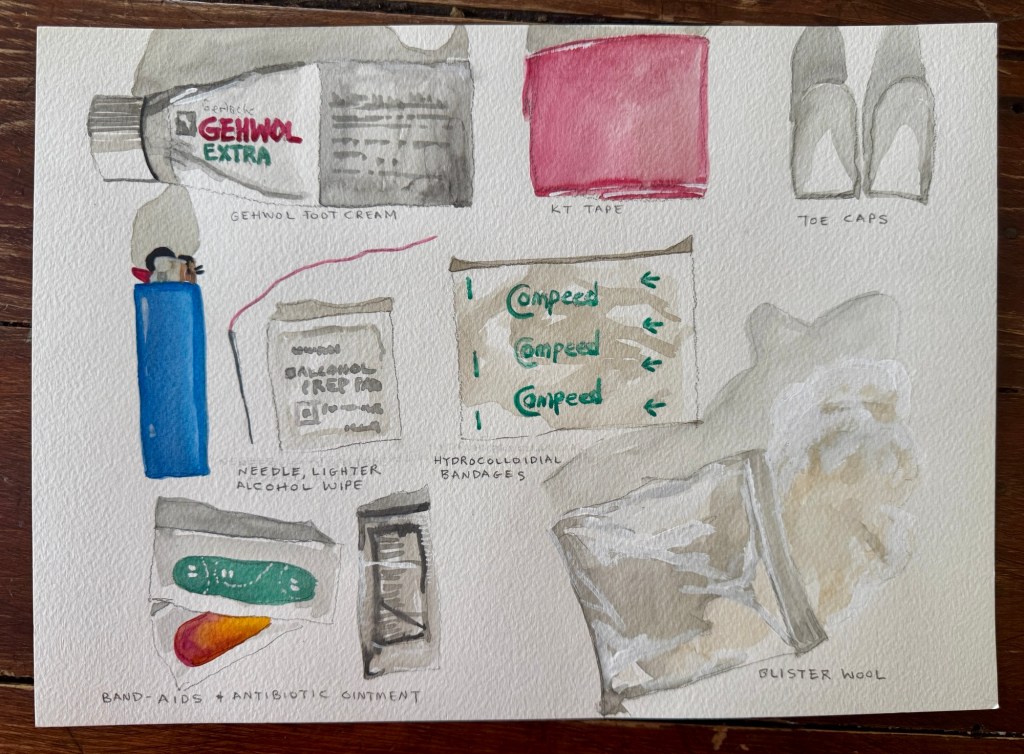
An Illustrated Guide to Blister Care and Prevention

10”x14” watercolor on paper

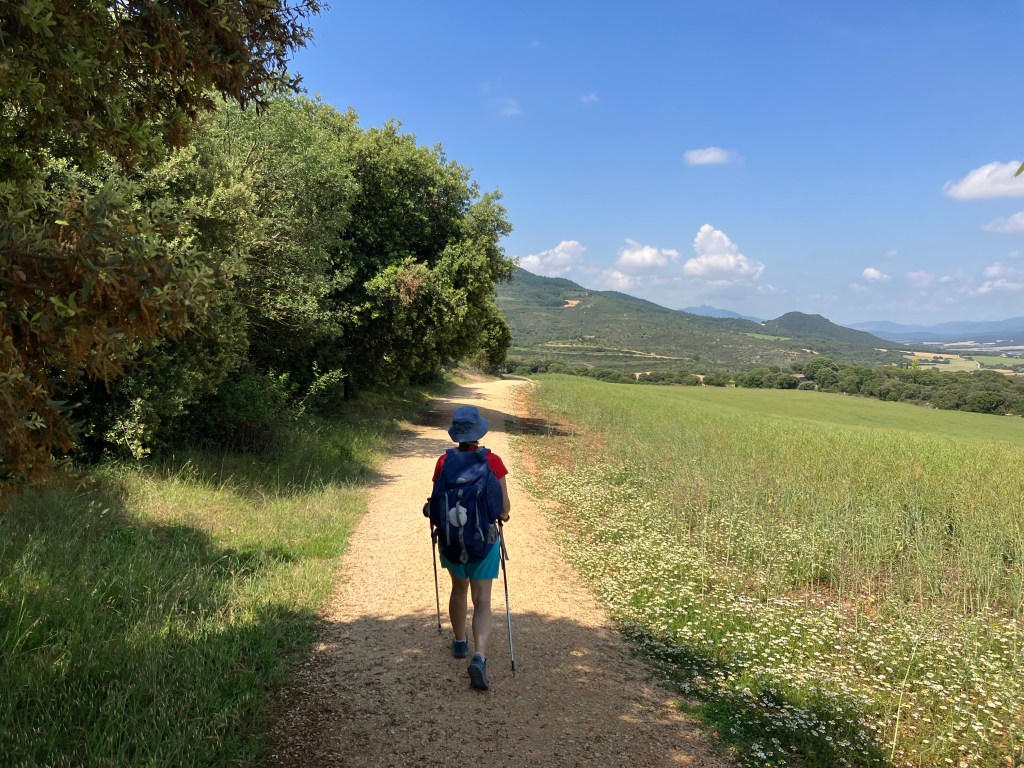
I am an artist who loves long walks.

While walking the Camino de Santiago, I came to see that tending blisters was an act of love, a way of living out these words: “Whatever you did for the least of these, you did it to me.” But love is not only intention—it is also preparation. My blister care kit became a ministry bag, filled with both prevention and healing.

Blister Care Kit Essentials

Good shoes: I reccomend trail running shoes with at least a thumb’s width at the toe (I love Altra Lone Peaks). Most blisters I saw came from boots or shoes that were too small.

Quality socks: Merino wool or other breathable fabrics. Keep shoes, socks, and feet clean—sand and dirt cause friction. On rainy days, change into dry socks midday.

GEHWOL Foot Cream: With eucalyptus, rosemary, lavender, lanolin, thyme, and camphor. Use after your shower at night and again in the morning. It moisturizes, helps prevent blisters (and athlete’s foot), and smells amazing!

Blister wool: Place on hot spots to cushion and “eat” friction before it causes blisters. I passed this out on the Camino like cotton candy.

Needle, lighter, and alcohol wipe: For puncturing fluid-filled blisters safely.

Hydrocolloid bandages: Cover popped blisters until healed.

KT tape: My favorite for hot spots—more flexible than moleskin. Works especially well with blister wool on almost-healed or not-quite-formed blisters.

Toe caps: Reusable silicone covers that protect tricky between-the-toe blisters.

A few band-aids and antibiotic ointment.

This kit reminded me daily that care for the body can also be care for the soul. To tend another’s feet on the Camino is to step into the story of Christ himself, who knelt to wash dusty feet with love. The road humbles us all. Each shared step, each act of tenderness, reminds me that our journey is not only toward Santiago, but also toward seeing Christ revealed in the weary, the wounded, and the ordinary moments of care along the way.

Buen Camino!

P.s. I have now walked the Camino Frances from St. Jean Pied de Port to the end of the world (twice) with NO BLISTERS!

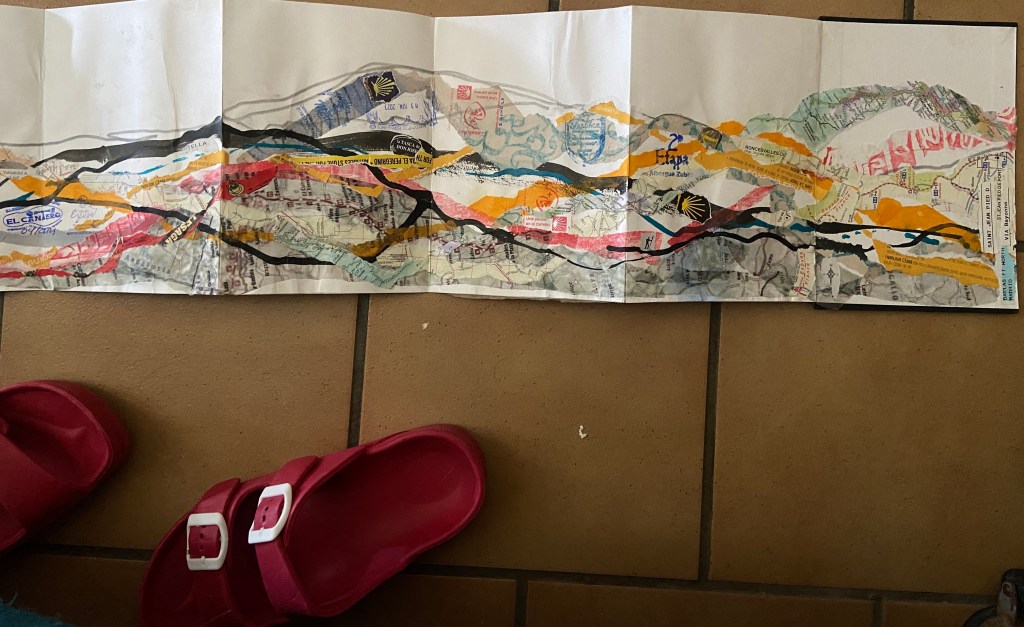
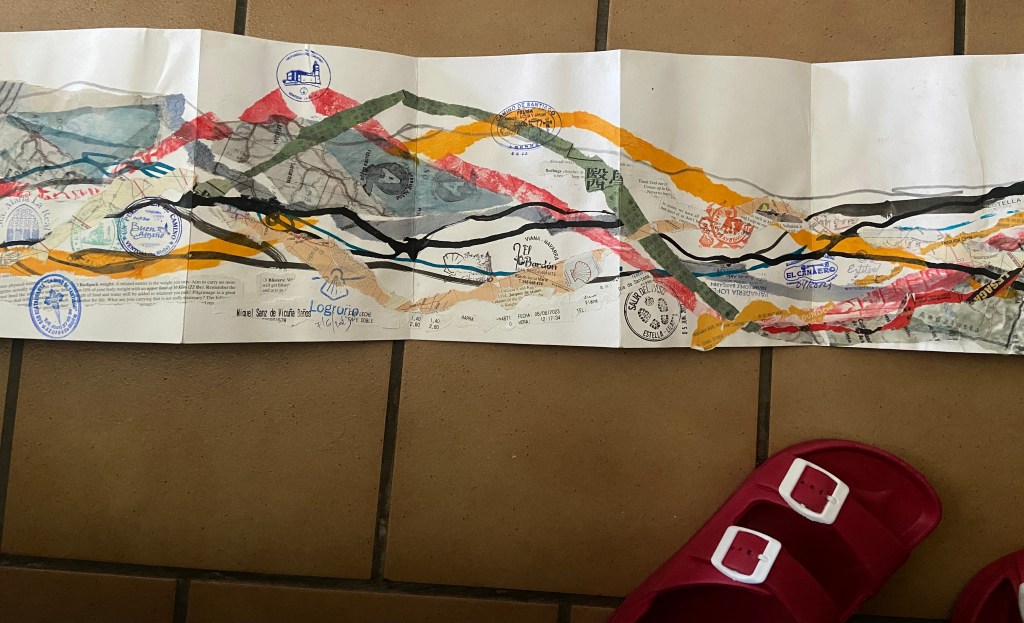
Camino Collage: days 1-10

Days 1-5. Concertina book. Collage and stamps collected along the Camino de Santiago, Spain.
Days 6-10. Concertina book. Collage and stamps collected along the Camino de Santiago, Spain.

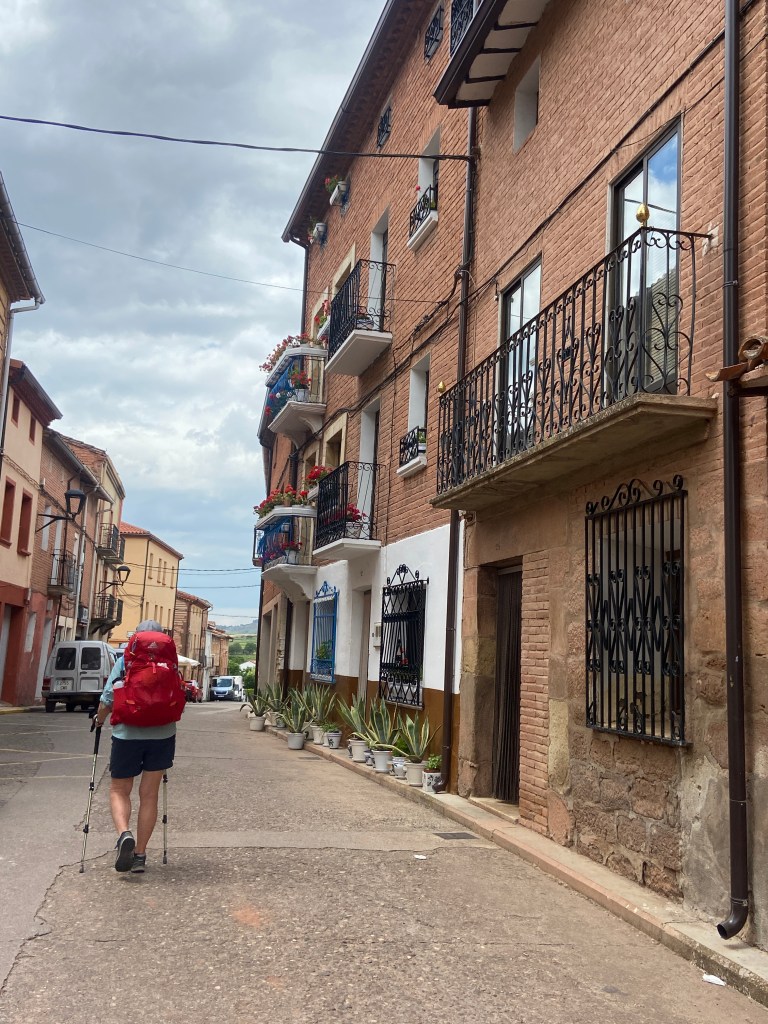
I am walking the Camino de Santiago with my family. It is a 500 mile pilgrimage. We started in France, and will walk to Santiago de Compostela and hopefully onto Finesterre – the end of the earth. We are currently in the Rioja region of Spain, we walk through vineyards on the same route pilgrims have walked for over 1,000 years.

Instead of making many small paintings along the way, I wanted to capture THE WAY itself. I am making a collage of all the bits and pieces I collect as I go. The lines represent the many paths of many pilgrims. We walk with friends and the we loose track of them, sometimes we meet up again a few towns later. The lines of collage weave in and out to represent the many people from all over the world making their way to Santiago. The lines of collage also (loosely) represent the topography and many hills. When you start walking you are issued a passport, and you collect stamps from places where you stop to rest or eat along the way. Those stamps are also added into my collage.

On the back side of my concertina book (not yet pictured) are notes of the many people and stories we are gathering as we walk.