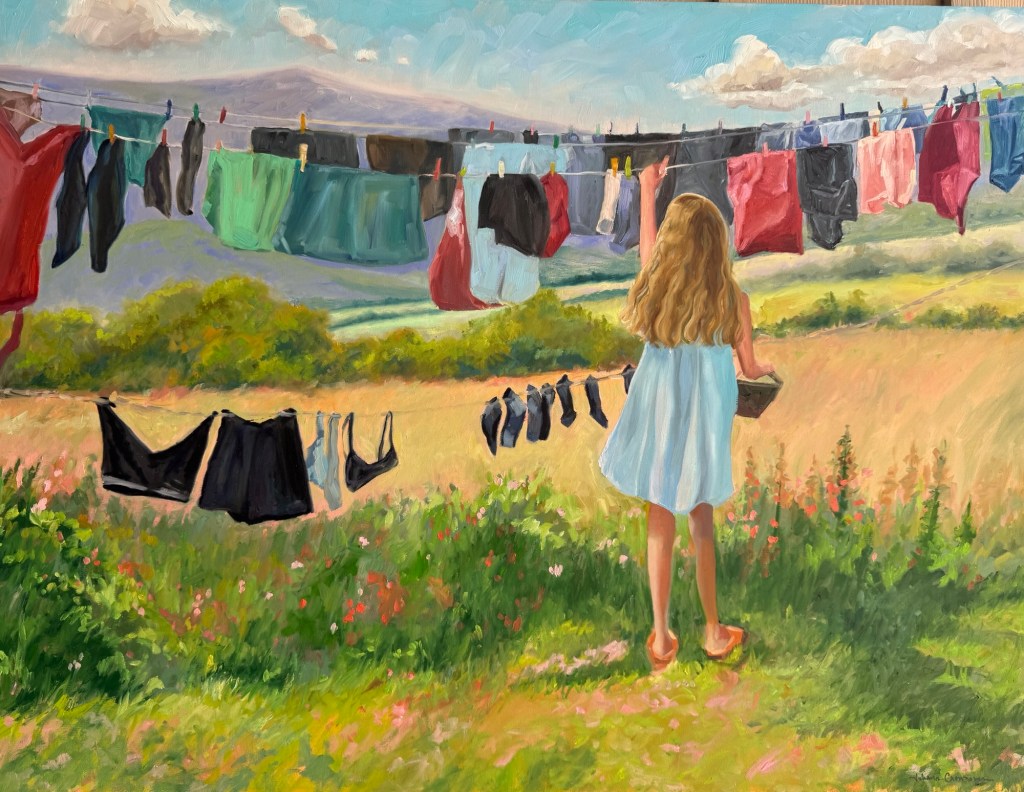
Wash day on the Camino

36”x48” oil on canvas

Wash Day

One afternoon, I stopped to watch two women doing laundry.

They were not pilgrims. They lived in the village and, like the women in the generations before them, they were washing clothes in an old communal stone basin. Water flowed steadily through the washhouse, as it had for centuries.

I wondered how many pilgrims had paused there before me—to fill a bottle, rinse a pair of socks, or simply watch ordinary life unfold.

The women worked easily together. One scrubbed while the other rinsed. They talked and laughed, their hands moving steadily through the water.

They made the work look almost light.

It struck me that they understood something we have nearly forgotten:

Work is easier when it is shared.

The Camino has a way of making this obvious.

You walk.

You sweat.

You wash your clothes.

The next day, you do it again.

There is no pretending that life is not made up of ordinary maintenance.

Every evening, clotheslines stretched between albergues and across courtyards, fluttering with shirts, socks, towels, and underwear from every corner of the world. Pilgrims gathered around sinks with bars of soap, exchanging stories as they scrubbed away another day’s dust.

Laundry was not separate from the pilgrimage.

It was part of it.

Watching the women at the stone basin reminded me of stories my grandmother told about Mondays at the laundromat.

Wash day was not simply about getting the clothes clean. Women from the neighborhood arrived with baskets of laundry, thermoses of coffee, sandwiches, and whatever dessert someone had baked that week. While the washing machines churned, they played cards and caught up on one another’s lives. Their children played nearby, weaving between baskets and folding tables.

The work created the gathering.

My own friends and I often did the opposite. We hurried through chores as efficiently as possible so we could take our children somewhere enjoyable: a park, a playground, somewhere that felt as though life were happening.

But those women let life happen where the work needed to be done.

Perhaps we have become so efficient that we have accidentally made ourselves lonely. Larger houses, better appliances, and private laundry rooms have made chores faster, but they have also made them solitary.

Convenience has given us speed.

It has stealthily taken away companionship.

One afternoon, my daughter stood beneath long clotheslines stretched across a hillside. Freshly washed clothes moved in the Spanish breeze while mountains rose in the distance.

She handed me clothespins as we hung our laundry together.

I remember thinking that this was a far more beautiful place to dry clothes than the inside of an electric dryer.

The Camino taught me that caring for ordinary things is not separate from a meaningful life.

It is the meaningful life.

Every day, our clothes become dirty.

Every day, we wash them.

Perhaps our souls are much the same.

They need regular tending—not because something has gone wrong, but because this is the rhythm of being human.

We walk dusty roads.

We gather around shared work.

We wash what has been soiled.

And each morning, we begin again—with clean clothes, lighter hearts, and gratitude for the hands working beside us.

ART SHOW!!! I’d love to invite you to the opening of When the Road Becomes Prayer: Paintings from the Camino de Santiago, an exhibition of paintings inspired by my family’s pilgrimage across Spain.

Please join me for the Opening & Artist Reception on Sunday, September 27 at 2:00 PM at the Justus Sundermann Gallery at St. Matthew’s Cathedral, 5100 Ross Avenue in Dallas. Admission is free, and covered parking is available.

I would be so happy to see you there. Come walk a little of the Camino with me.
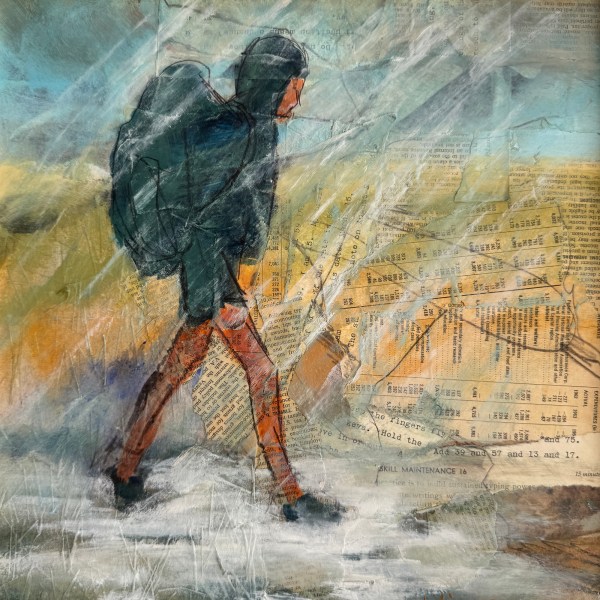
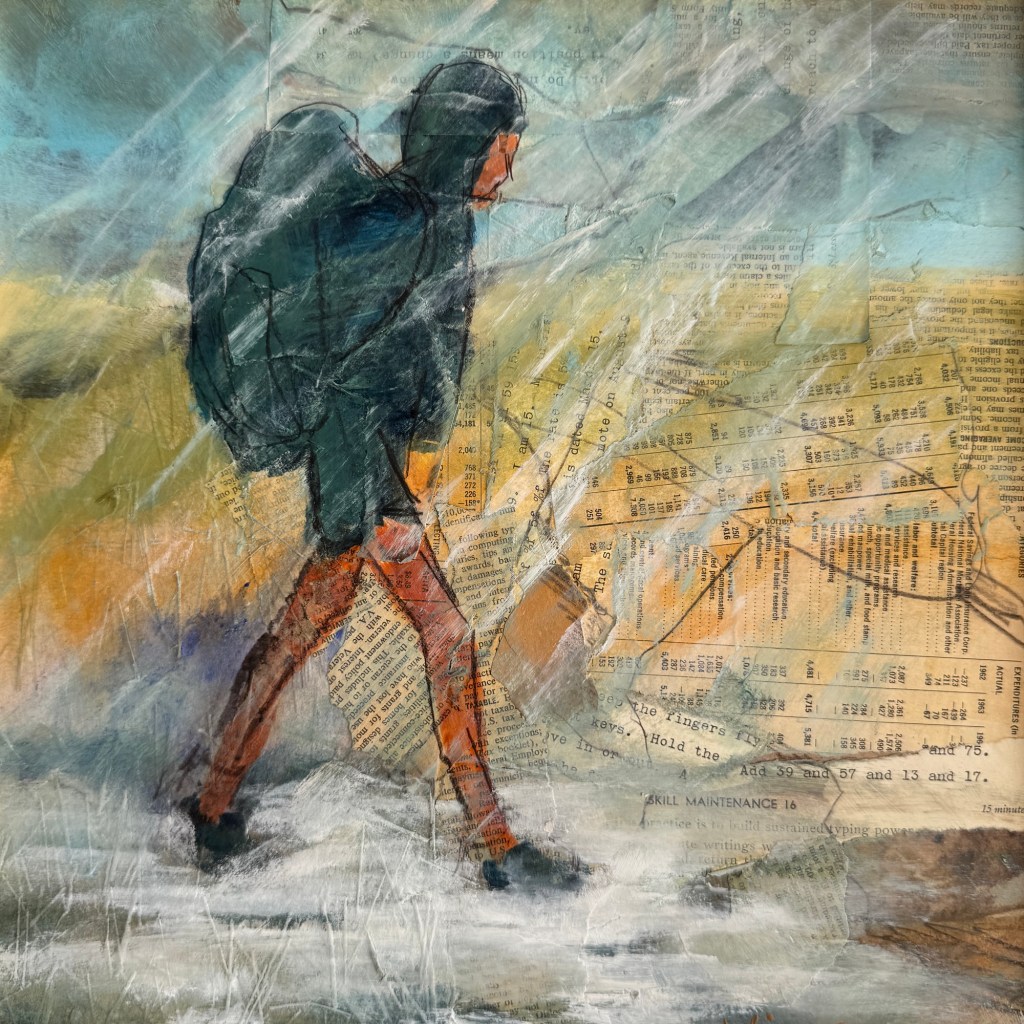
The Weight We Choose

12” · 12” oil, cold wax, and collage

The Pack of Fear

At the beginning of the Camino, I hated my pack.

It clung to me—a stubborn weight, always present, always asking something of my body. I thought it was heavy because I was not strong enough.

But it was heavy because it was full of fear.

I had packed for every what if, every just in case, every quiet doubt that whispered I would not be enough unless I carried more.

I am a mother. I am the one who anticipates, prepares, and provides. I carry the extra snacks, the medicine, the rain gear, and the things no one thinks they will need until suddenly, they do.

I am the just in case.

Also, I come from abundance, from a life in which there is usually more than enough. More food than we eat. More clothing than we wear. More belongings than we use.

Still, we gather more.

Excess has a cost.

What we carry, we must tend.

What we own, we must store, protect, and keep.

Too often, what we keep is never used at all.

Day after day, as we walked from village to village, I began to notice small cloth bags hanging beside doors and mailboxes.

At first, I did not understand what they were.

Then I smelled the bread truck before I saw it—warm, yeasty, alive.

The truck passed through villages without bakeries, leaving bread in the waiting bags. Each household received only what it needed for that day.

Give us this day our daily bread.

In the desert, the Hebrews learned that tomorrow’s provision could not be gathered in advance. Manna would not keep. It could not be stored or controlled, only received and used.

I had spent much of my life trying to gather tomorrow’s bread today.

I carried extra food because someone might get hungry. I carried things my children could carry for themselves. I carried the fear that if I did not anticipate every need, someone would go without—and it would be my fault.

Slowly, the Camino began to loosen my grip.

I did not need to carry food for everyone. They could carry their own.

I did not need to save yesterday’s bread. Today would come with its own provision.

Yesterday’s loaf only grew damp with rain—stale, heavy, and forgotten at the bottom of my pack.

And still, I carried.

Until I didn’t.

Little by little, I began to trust.

Trust that there would be enough.

Trust that my family could carry some things for themselves.

Trust that I did not have to be everything for everyone.

Trust that what I needed would meet me when I arrived.

The weight of my pack did not disappear all at once.

As I let go of what I did not need, I began to understand that the heaviest things I carried were never the things inside it.

They were my fear of being unprepared,

my fear of being dependent,

my fear that daily bread might not be enough.

The Camino did not promise I would never go without, but it did teach me

 that I do not have to carry tomorrow before it comes.

A Pilgrim’s Pause

12” · 12” Oil, cold wax, and collage

A Pilgrim’s Pause

The Camino took us through the middle of life.

Through tiny villages and busy cities, past open windows, cafés, shopkeepers, children playing, laundry hanging, and neighbors talking in the street.

We were walking through Spain at the speed of humans—slowly enough to notice.

This painting holds one of those ordinary moments: a pilgrim pausing on a street while life continues around her.

Nothing extraordinary happened.

And perhaps that is why I wanted to paint it.

We Were Never Meant to Walk Alone

We Were Never Meant to Walk Alone
36” · 48” Acrylic and oil on canvas

Because They Had Less

We met a pilgrim named Beau who was walking with his wife and their seventeen-year-old son.

They had been covering long distances and feeling strong—until suddenly, they were not.

Beau suffered a severe flare-up of gout. By the time they reached their albergue one evening, he was in terrible pain. He struggled up the stairs to their room and could barely move.

His wife went downstairs to the café and asked if she could take dinner up to him.

“That is not an option,” the hospitalero told her. “He must come down and eat in the café.”

She was tired and worried. As she climbed the stairs to help Beau, she thought, I should have carried more food.

Together, she and their son helped him down to the café.

The moment the hospitalero saw Beau, his firmness disappeared.

“Oh, no! What happened? What is wrong?”

In broken Spanish, they tried to explain the gout and the pain in Beau’s foot.

Then the hospitalero lived fully into the meaning of his name.

He welcomed them to the table and fed them. While they ate, he called a local doctor. The doctor arrived with a pharmacist and someone who could translate.

No one asked for payment.

Had their packs been full, heavy with provisions intended to protect them, they might have remained upstairs, alone in their suffering.

They would have eaten.

But they would have remained unseen.

Instead, their need became an opening.

Because they had less, they received more.

Because they could not carry everything, they were carried.

At a simple table in a small Spanish village, they received far more than dinner or medicine. They received the care of strangers who saw their need and responded as though they belonged to one another.

There, they tasted something more delicious than bread.

They tasted trust.

As their packs grew lighter, something else began to fill the empty space—not more possessions, but gifts:

Gratitude that catches in the throat.

Humility that softens the heart.

And the wisdom that we were never meant to walk this road alone.

I’m so excited to invite you to the opening of When the Road Becomes Prayer: Paintings from the Camino de Santiago. This exhibition brings together paintings and stories inspired by walking the Camino with my family—what we carried, what we received, and what the road taught us along the way. There are many more paintings and stories to share! Please join me for the opening and artist reception Sunday, September 27 at 2:00 PM at St. Matthew’s Cathedral in Dallas. I would love to see you there!

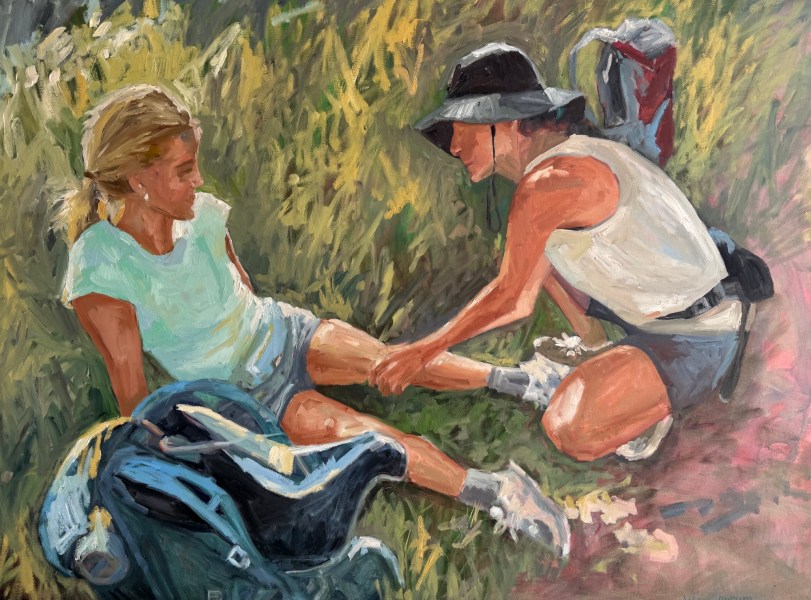
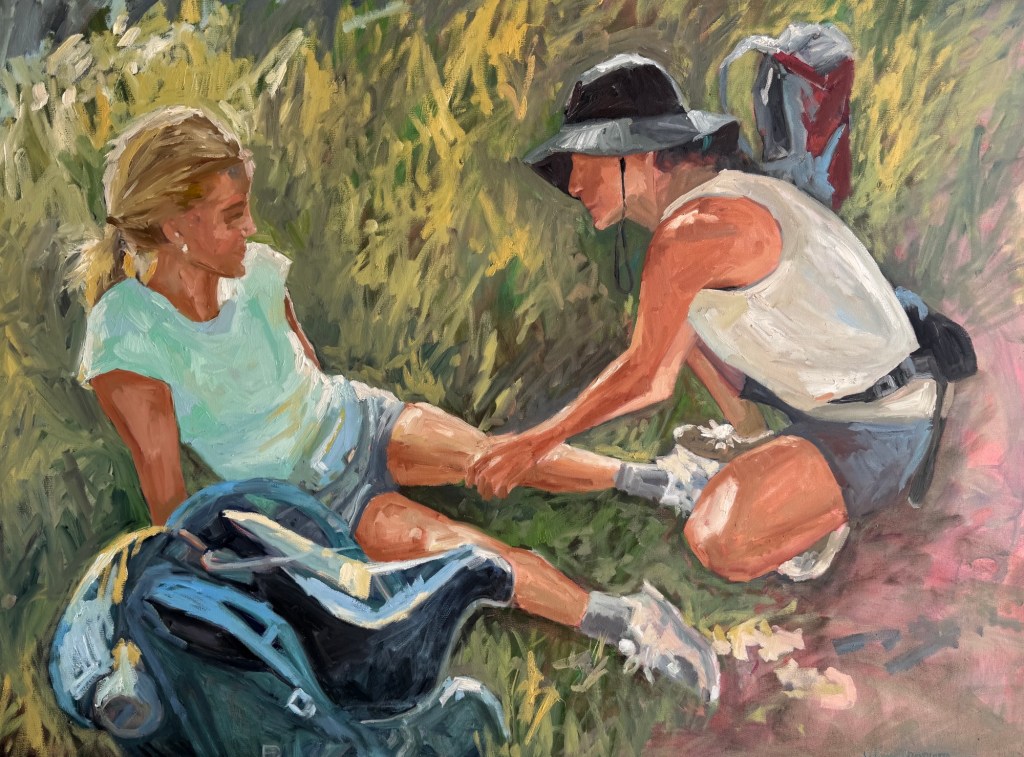
She Stopped

36” · 48” Oil on canvas

One afternoon on the Camino, we came to the base of a long hill.

It was late and it was hot—

the kind of heat that slows your steps and stretches the hills taller than they are. 

At the side of the path, a woman sprawled on the ground, unable to continue. One pilgrim glanced at her, crossed to the other side of the road, and kept walking. A couple stopped and asked if she needed anything. “No,” she said, the way we often do when accepting help feels harder than enduring the pain alone.

Then my friend Sara arrived.

She did not stand above the woman and ask another question. She set down her pack and sat beside her. “What are we dealing with?” she asked. The woman explained that her leg had seized with a painful cramp and that she could go no farther. Sara smiled gently. “I’m good at massage,” she said, “and I just bought some oil from a women’s cooperative. May I try to work it out?”

This time, the woman said yes.

Slowly and patiently, Sara massaged the cramped muscle until the pain began to ease. Little by little, movement returned. Then the two women stood.

Three pilgrims climbed the hill together.

As I watched them walk, I recognized the parable of the Good Samaritan, 

not told in a church, but written in sweat, road dust, and kindness.

Compassion did not announce itself.

It simply sat down.

The quiet miracle was not only that Sara stopped. It was also that the injured woman found the courage to receive what was offered. Along the road, may we be the ones who notice. The ones who stop. The ones who sit beside another person in pain.

And when we are the ones lying at the foot of the hill, may we also find the grace to say yes.

I’m so excited to invite you to the opening of When the Road Becomes Prayer: Paintings from the Camino de Santiago. This exhibition brings together paintings and stories inspired by walking the Camino with my family—what we carried, what we received, and what the road taught us along the way. There are many more paintings and stories to share! Please join me for the opening and artist reception Sunday, September 27 at 2:00 PM at St. Matthew’s Cathedral in Dallas. I would love to see you there!