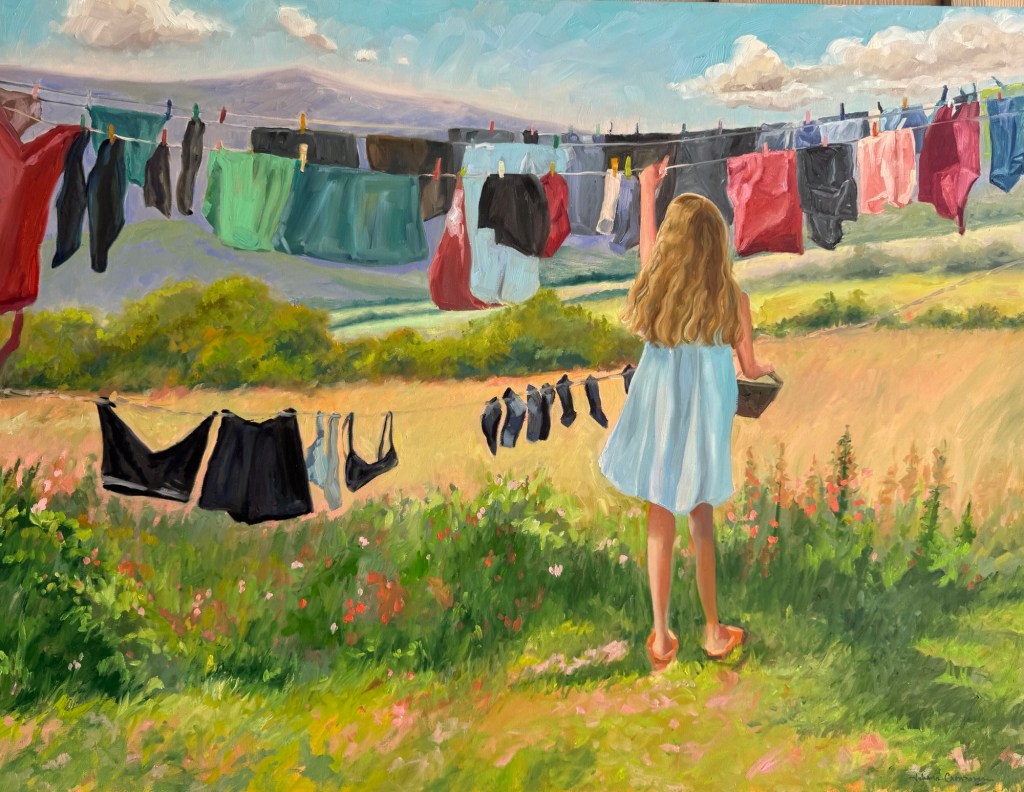
Wash Day
One afternoon, I stopped to watch two women doing laundry.
They were not pilgrims. They lived in the village and, like the women in the generations before them, they were washing clothes in an old communal stone basin. Water flowed steadily through the washhouse, as it had for centuries.
I wondered how many pilgrims had paused there before me—to fill a bottle, rinse a pair of socks, or simply watch ordinary life unfold.
The women worked easily together. One scrubbed while the other rinsed. They talked and laughed, their hands moving steadily through the water.
They made the work look almost light.
It struck me that they understood something we have nearly forgotten:
Work is easier when it is shared.
The Camino has a way of making this obvious.
You walk.
You sweat.
You wash your clothes.
The next day, you do it again.
There is no pretending that life is not made up of ordinary maintenance.
Every evening, clotheslines stretched between albergues and across courtyards, fluttering with shirts, socks, towels, and underwear from every corner of the world. Pilgrims gathered around sinks with bars of soap, exchanging stories as they scrubbed away another day’s dust.
Laundry was not separate from the pilgrimage.
It was part of it.
Watching the women at the stone basin reminded me of stories my grandmother told about Mondays at the laundromat.
Wash day was not simply about getting the clothes clean. Women from the neighborhood arrived with baskets of laundry, thermoses of coffee, sandwiches, and whatever dessert someone had baked that week. While the washing machines churned, they played cards and caught up on one another’s lives. Their children played nearby, weaving between baskets and folding tables.
The work created the gathering.
My own friends and I often did the opposite. We hurried through chores as efficiently as possible so we could take our children somewhere enjoyable: a park, a playground, somewhere that felt as though life were happening.
But those women let life happen where the work needed to be done.
Perhaps we have become so efficient that we have accidentally made ourselves lonely. Larger houses, better appliances, and private laundry rooms have made chores faster, but they have also made them solitary.
Convenience has given us speed.
It has stealthily taken away companionship.
One afternoon, my daughter stood beneath long clotheslines stretched across a hillside. Freshly washed clothes moved in the Spanish breeze while mountains rose in the distance.
She handed me clothespins as we hung our laundry together.
I remember thinking that this was a far more beautiful place to dry clothes than the inside of an electric dryer.
The Camino taught me that caring for ordinary things is not separate from a meaningful life.
It is the meaningful life.
Every day, our clothes become dirty.
Every day, we wash them.
Perhaps our souls are much the same.
They need regular tending—not because something has gone wrong, but because this is the rhythm of being human.
We walk dusty roads.
We gather around shared work.
We wash what has been soiled.
And each morning, we begin again—with clean clothes, lighter hearts, and gratitude for the hands working beside us.
ART SHOW!!! I’d love to invite you to the opening of When the Road Becomes Prayer: Paintings from the Camino de Santiago, an exhibition of paintings inspired by my family’s pilgrimage across Spain.
Please join me for the Opening & Artist Reception on Sunday, September 27 at 2:00 PM at the Justus Sundermann Gallery at St. Matthew’s Cathedral, 5100 Ross Avenue in Dallas. Admission is free, and covered parking is available.
I would be so happy to see you there. Come walk a little of the Camino with me.
 paintandsimple